

I am a serial killer
Confessions from a girl who killed to survive

Chapter 34
I’m a serial killer.
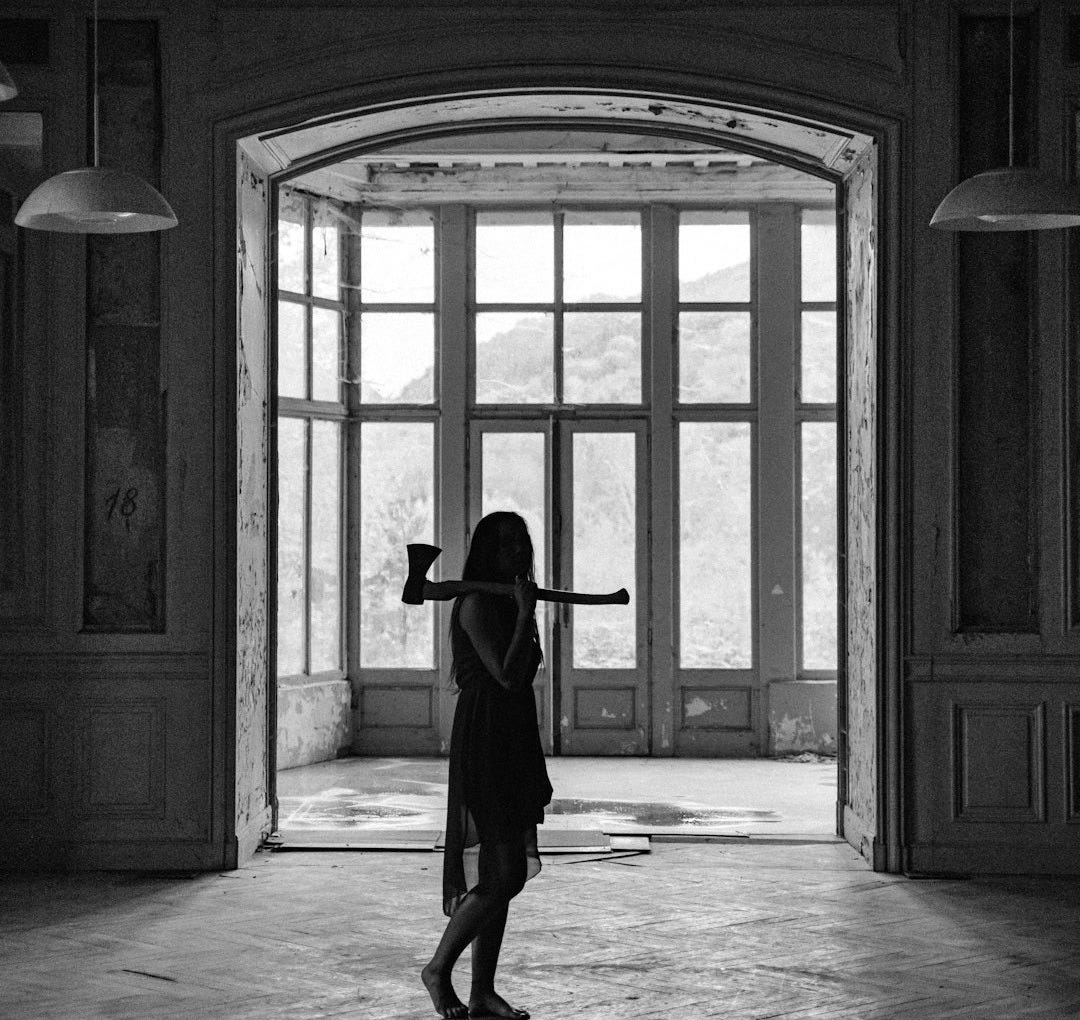
Not the kind that headlines the news. Not the one they profile on TV. My crimes happen in plain sight, in closed rooms over a page, in therapy offices or on bathroom floors at 3am, in the endless corridors of my mind where no one else can hear the screaming.
I’ve murdered so many versions of myself I’ve lost count.
I have killed and killed, repeatedly, viciously, willingly. And the victims? The poor victims. They begged. They tried to save themselves with memories and proofs of “better times.” I showed no mercy. I can still see them. They all had my face.
The worst part? Mostly, I didn’t care. I had to do it. I was planning the murders for the longest time, weeks, months, years even. I was choosing the weapon, rehearsing the speech, and then I was standing at the crime scene, saying goodbye and reading the eulogy to who I used to be.
People noticed. They flinched, shifted in their chairs, searched for words, then looked away and pretended not to see. They thought the murder was sudden, abrupt, unexpected. A shock to the system.
But that’s only because they weren’t paying attention. If they had been, they’d have seen the planning, the premeditation. The small vanishings. The quiet erasures. The slow, deliberate unmaking that unfolded over years.
When this kind of “growth” happens, it feels like betrayal to those who loved you. They didn’t notice the dying, but they still call it unforgivable, a quiet execution of your best parts. To them, you committed a cold-blooded murder of a cherished memory. The version of you they needed you to be.
But let me tell you about my victims.


The first body
There’s the girl I killed at nine.
She was troubled, confused, trying to make sense of the world and her surroundings. She couldn’t remember her past. Sometimes I think she didn’t live before nine, like she was born already broken, already carrying weight too heavy for her small shoulders. So many unspoken truths living in her bones.
She was scared and fearless at the same time, that particular combination only children who’ve seen too much can manage.
She had opinions about everything and shared them with the confidence of someone who didn’t yet know that taking up space was a privilege, not a right. She hadn’t learned yet that the world prefers quiet girls, compliant girls, girls who know how to make themselves smaller.
She wanted to be different. She wanted to escape. She laughed with her whole body and cried over open wounds and sad stories she couldn’t escape from, as if grief was something she could outrun if she just felt it hard enough.
I drowned her in silence during my teenage years.
Held her head under the water until she stopped asking questions, stopped interrupting, stopped being too much. It was an act of mercy, really, or so I told myself. The world was already sharpening its knives for her. I just got there first. A preemptive strike against inevitable violence.
She died believing she was doing something wrong by existing too loudly, by aching too deeply for everything and everyone, by refusing to understand that survival meant silence.
She became something else, an ethereal girl who buried her grief beneath silence and pain. A ghost of herself. A prettier corpse. Less demanding. Finally acceptable.
The crime scenes
Do you know what survival is? Sometimes the only way to survive is to murder the parts of yourself that the world has decided are unacceptable. And you do it so efficiently, so thoroughly, that you don’t even recognize it as violence.
You call it adaptation. You call it learning. You call it “picking your battles.”
You don’t call it what it is: preemptive assassination of your own aliveness.
At twenty, I killed the teenager who thought she deserved tenderness, the one who carved her pain into skin just to prove she could still feel. She mistook numbness for healing and silence for strength.
Smothered her with the pillow of “life isn’t fair” and “toughen up” and “at least it wasn’t worse.” She died slowly, over months of learning that pain was just normal, something you endure, not something you’re allowed to complain about.
A passing storm, not a cry for help.
I also killed the woman who believed love should feel safe. Pushed her off the cliff of “this is just how relationships are” and “nobody’s perfect” and “this is what you deserve because you never experienced better.” She shattered on the rocks of low expectations, and I buried her remains under the floorboards of “at least someone wants me.”
And the worst murder of all? The person I thought I was for decades, carrying crumbs of regret, guilt, and remorse, wearing the prettiest masks and rehearsing the bravest speeches, pretending she was safe.
I locked her in a mental clinic and then, one night, I stabbed her. Again and again. Her eyes met mine. Blood spattered the white walls. We both cried.
I held her body for days, whispering the lullabies we used to sing. Her last words?
“Thank you for saving me.”
The method
There’s a certain ritual to these murders. My method? Starvation. I starved them of the one thing they needed most: permission to feel.
Trauma teaches you a cruel economy: feelings are expensive, dangerous, survival-threatening. So you learn to kill them on sight, before they can kill you. Grief becomes “get over it.” Anger becomes “let it go.” Fear becomes “stop being so sensitive.”
You end up fluent in emergency and illiterate in your own emotional language. You can handle a crisis with surgical precision and still have no name for the thing that wakes you at 4 a.m., with a tight chest and swallow breath. Is it anxiety? Grief? The slow, fermenting rage you’ve been composting for fifteen years?
You slit it down before you can even ask.
At first, it feels like control, the ability to shut down, to keep moving, to handle anything. But the body keeps the inventory even when the mind denies it. The unspoken doesn’t vanish. It waits.
I have a morgue full of feelings I killed before I could name. They’re all there, preserved in the formaldehyde of “I’m fine”, “whatever”, “I don’t want to talk about it” and “I don’t feel anything.”
There’s the rage I killed at twelve when I learned that angry girls are “crazy” and “dramatic.” I strangled it with a smile and learned to say “no worries” when I meant “this is not okay.” I learned to swallow fire and call it digestion.
There’s the grief I suffocated at nineteen because sadness was “self-indulgent” and “attention-seeking” and there were people with “real problems.” I learned to cry in the shower where the water could muffle the sound, where even my sadness knew to keep quiet.
There’s the joy I poisoned in my twenties because happiness felt dangerous. I didn’t know how to hold it, so I drowned it like a setup, like the universe’s favorite punchline. I learned to brace for disaster the moment things felt good, to kill it before life could kill it for me. Better to be the executioner than the executed.
And then came the sorrow of my thirties, familiar, heavy, almost comforting in its constancy. I wore it like a flag, like a second face. Until one day, I decided even my sadness was too much to bear, and I shot it down without hesitation, clean and final. No ceremony this time. Just efficiency.
The investigation
Do you know what’s the strangest thing about being a serial killer of selves? Eventually, you run out of victims. You’ve murdered so many versions of yourself that one day, you look in the mirror and don’t recognize who’s looking back.
And that’s when the haunting begins.
They come back, these dead selves. Not as ghosts exactly, I can’t explain it, but they come back as questions. As aches without names. As flashes of memory you can’t place, and the feeling that something’s missing, though you can’t remember what. As the exhaustion of trying to be someone you’re no longer sure exists.
That’s when you realize: you can’t kill your way to wholeness. You can’t amputate your way to peace. And you definitely can’t bury the parts of you that were only ever trying to survive.
You can only see them through. Forgive them. Hold them until they feel safe enough to walk toward the light.


So you start investigating your own crimes. You start asking questions you’ve been trained not to ask:
What if the parts of me I killed were actually the parts of me that were most alive?
What if “too much” was actually “just right” and the world was simply too small, or not ready?
What if my feelings aren’t the enemy but the language I forgot how to speak?
You start learning, slowly, painfully, that emotions and thoughts aren’t there to control you. They’re there to guide you.
You learn to quiet the noise long enough to notice them, to listen, to direct them instead of being driven by them. That’s when it hits you, that being emotionally aware isn’t about having pretty feelings. It’s about being able to name what’s happening inside you. To call the beast by its true name.
You’ve stayed silent for so long that now, the feelings start talking back. And they’re saying things. Oh, they’re saying so many things.
About the difference between “I feel fine” and “I’m scared and pretending I’m not.” Between “whatever” and “I feel hurt and don’t know how to say it.” Between “I care about you” but “you’re suffocating me.”
It’s about understanding that you can’t heal what you can’t feel, and you can’t feel what you can’t name. That healing requires vocabulary before it requires courage.
The resurrection
So here I am, trying to resurrect my victims. Trying to exhume all the parts of myself I buried in unmarked graves and give them proper names. Proper funerals. Proper grief. The ceremonies they deserved all along.
It’s messy work. Some days I’m not sure if I’m healing or falling apart. (Some days I’m learning those might be the same thing.)
I’m learning to feel my feelings before I kill them. To sit with discomfort instead of smothering it. To name the thing before I murder the thing.
I’m learning that “I feel angry” is a complete sentence. That “I feel scared” doesn’t need a disclaimer. That “I feel broken” isn’t a moral failing.
I’m learning that the little girl I killed at nine? She wasn’t wrong for being different. She couldn’t have known better. She was lost and confused, and the world didn’t know better either. So they demanded her silence. I delivered it with my own hands.
And…I’m learning that the opposite of killing your feelings isn’t drowning in them. It’s learning to swim next to them. It’s learning to let them float, without pushing them down with your bare hands and disgust in your eyes.
You can feel rage without being rage. Feel fear without being fear. Feel grief without being grief.
The confession
So yes, I’m a serial killer.
But I’m also, tentatively, carefully, one feeling at a time, trying to stop.
Can I stop? I don’t know.
I think being a killer is like alcoholism or any other addiction…you don’t really escape it. You just live your life waiting for the relapse, one emotional crisis away from a murder, from falling back into old patterns of elimination.
I’m trying to learn the language I was never taught. The language of naming what’s happening inside me without immediately setting it on fire.
It’s slow work. Some days I still reach for the knife. I still think in bloody scenarios and detailed preparations. I still want to kill the feeling before it kills me. And I still believe it’s a battle with only one survivor.
But other days, more days now, I manage to say it out loud: “I feel scared.”
“I’m grieving something I can’t name yet.”
I’m grieving my old selves, the ones who didn’t know better, who kept me alive by dying first. Necessary sacrifices or needless casualties, I’m still not sure which.
I feel pain and relief in the same breath. They’re gone, but they’re still here, still trying to teach me something tender about who I’ve become.
I ache for the way they lived and the way they died. For not being there sooner. For not helping them understand better. For not knowing that survival would look so much like surrender, for the girl who never got a goodbye.
They probably didn’t deserve this death.
I am a serial killer.
But I’ve decided the feeling doesn’t kill me anymore.
And I don’t kill it either.
We just…sit there, two survivors at the same table, getting acquainted, learning each other’s names, practicing the slow art of coexistence.
Until next time,
Stay messy, stay brave, keep naming what you once silenced.
Eleni
You can’t resurrect your voice if you keep burying your feelings alive. — Eleni Rizopoulou
👉 Let’s talk about what we bury to survive, and what it costs us to stay silent.
💬 Which part of this story felt closest to you, the killing, the haunting, or the resurrection?
✨ Share your reflections below. Every story of survival deserves to be spoken, especially the ones we’ve kept buried the longest.
Every Monday at 10:30 CEST, the Glorious Fail shows up to meet you where you are, and push you where you’re meant to go.
The Glorious Fail is just getting started. And every voice here shapes what it becomes. We’re unlearning the silence, reclaiming the story, and writing a braver one, together. There are plenty of ways to support it:
→ If this landed a little too close to home, give it a like.
→ If you have thoughts, feedback, or just want to say hi, drop a comment.
→ And if it cracked something open and want to spread the word, hit that restack button below.
💭 Want more emotional fluent related brain-bending insights? [Follow me on Linkedin]
This was hard to read in the best way
So raw and beautiful. You tapped into so many feelings I’ve hidden throughout the years (so many versions I removed!) in an effort to be more likable, palatable, perfect.
I especially liked where you share: “There’s the joy I poisoned in my twenties because happiness felt dangerous. I didn’t know how to hold it, so I drowned it like a setup, like the universe’s favorite punchline. I learned to brace for disaster the moment things felt good, to kill it before life could kill it for me.” It’s fascinating how we can create our own upper limits on happiness, given the stories that are shared amongst us.
Writers like you are showing us that we can change these narratives, we can teach others what’s possible (and perhaps heal our younger self while we’re at it).