

The Familiar Stranger
Your future self already exists, but your nervous system hasn’t met them yet


Chapter 43
Think of your identity as a house you’ve lived in for so long you could move through it in the dark.
You know which floorboards complain under your weight. Which doors need a gentler hand. Where the morning light pools, and how certain corners glow when the day begins to let go. The walls have memorized your patterns, the air carries the scent of your habits, and every room whispers the familiar story of who you’ve been.
Now imagine trying to convince yourself you live somewhere else entirely, a house you’ve only seen in photographs, never walked through, never slept in. Your body would resist not because the new house is not beautiful, but because it doesn’t feel like home.
This is what happens when you try to become someone your nervous system hasn’t experienced yet.
Your brain is not asking you what you want to become. It is asking you who you are right now, in this moment, as you read these words. And it is answering that question not through your thoughts or your intentions, but through something far more fundamental, your emotional state, your nervous system patterns, and the experiences you’ve accumulated like sediment in the riverbed of your consciousness.
Yes, there’s an uncomfortable truth that lives at the intersection of neuroscience and transformation. Your future self already exists as a possibility within you, but your brain won’t let you become someone it hasn’t met yet.


The question beneath every thought
Every moment, beneath the surface of your awareness, your brain is running a continuous assessment: Who am I? It answers this question not philosophically but viscerally, drawing from your emotional states, your nervous system patterns, and the repeated inner experiences that have taught it what “you” feels like. This is not the identity you aspire to or the person you promise yourself you’ll become on Monday morning. This is the identity your nervous system recognizes as safe, familiar, and survivable.
We live under the illusion that identity is built from the outside in, that if we just achieve enough, acquire enough, or accomplish enough, we will finally become the person we’ve been trying to be. But your brain doesn’t work that way. It doesn’t update your sense of self based on your resume, your acquaintances or your aspirations. It updates based on felt experience, on the emotional and physiological states that signal to your nervous system: This is what being me feels like.
And it can be way more complicated. Your future self, the confident one, the healed one, the version of you that has moved beyond old patterns, already exists as a potential identity in your brain. But if your nervous system doesn’t recognize that identity as safe or familiar, it will default back to what it knows. This is why change feels hard even when you desperately want it. Your brain is not being stubborn. It is being protective.
Resistance is not your enemy. It’s your nervous system saying: I don’t recognize this version of us yet. Meet me here. Show me it’s safe.
The neuroscience of identity shift
There’s a concept in neuroscience called neuroplasticity, the brain’s ability to rewire itself, to form new pathways and loosen old ones. But neuroplasticity doesn’t respond to willpower or positive thinking. It responds to experience. Specifically, to experiences that carry emotion, imagery, and a felt sense of reality in the body.
When something feels real to your nervous system, your brain updates its predictions about who you are and what’s possible for you.
This is the hinge point of transformation.
Your brain doesn’t clearly distinguish between what you’re living and what you’re vividly imagining while feeling. When you meet your future self through imagery, when you sense their emotional state, their posture, their internal steadiness, your brain receives that encounter as data. Not as fantasy, but as information.
That version of you becomes a reference point. A felt encounter your nervous system can orient toward.
Through consistency, meeting that version again and again, while cultivating the emotional state that matches it, your system starts to register something crucial: This feels familiar. This feels safe. This could be me.
And that’s when behavior begins to shift. Without force or self-discipline.
But because your nervous system has updated its answer to a very old question: Who am I?
Effort alone never works
This is where most of us go wrong. We assume we become our future selves by trying harder, by pushing through resistance, white-knuckling new habits, forcing ourselves to act like the person we want to be. And for a while, that strategy can work. We hold the effort. We see movement. We feel hopeful.
But then something collapses.
We revert. We stall. We find ourselves back in familiar patterns, wondering why the change won’t stick. And almost inevitably, we blame ourselves, for lacking discipline, for being inconsistent, for not wanting it badly enough.
But effort was never the issue. The issue is that you were trying to inhabit an identity your nervous system didn’t know yet. You were asking your body to live in a house it had never entered, let alone learned was safe.
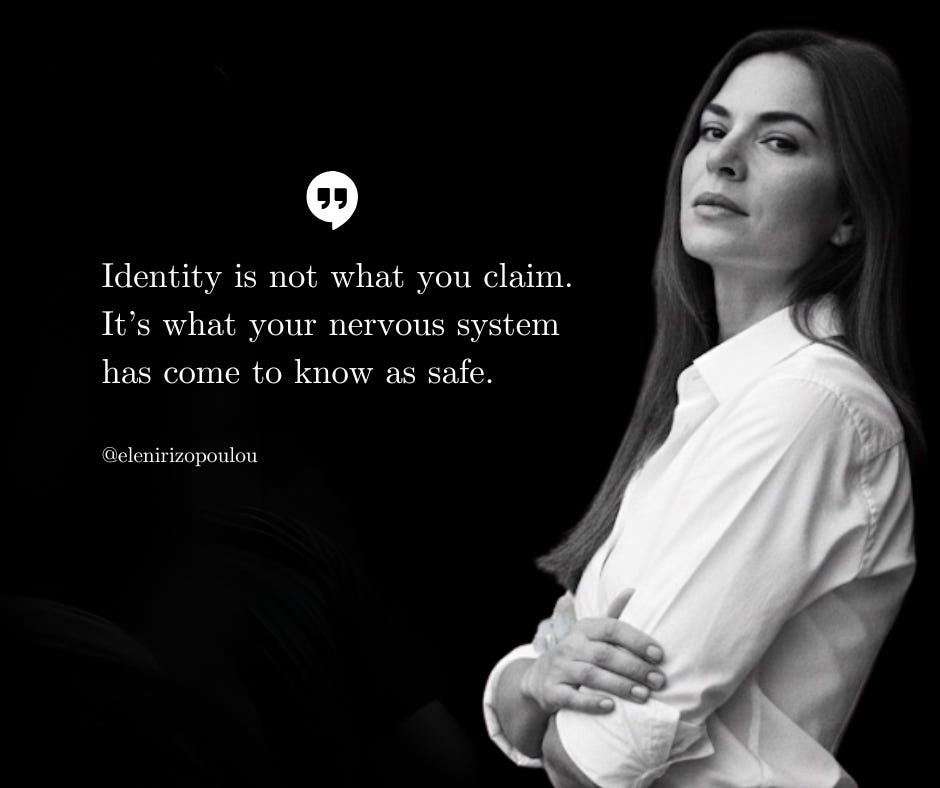
Your nervous system doesn’t respond to who you intend to be. It responds to who you have experienced yourself as.
You don’t become your future self by pushing toward them. You become them by meeting them, repeatedly, emotionally, somatically, until your system learns the terrain.
Until that identity stops feeling foreign. Until it registers as familiar. Until it feels survivable.
That’s when effort gives way to coherence. That’s when you stop trying to become someone, and start acting from who you already are.
Emotional congruence
There’s a reason why visualization alone often fails. Imagination without emotion can’t reach the nervous system. Your brain doesn’t change because it sees a picture, it changes when it feels a life.
When you imagine your future self and simultaneously cultivate the emotional state they would inhabit, the calm, the confidence, the groundedness, you’re not just daydreaming. You’re training your nervous system to recognize that state as accessible. You’re teaching your brain that this version of you is not some distant fantasy but a lived possibility that exists within your nervous system’s range.
This is emotional congruence. When your inner state matches the identity you’re cultivating. When the body and identity stop arguing. And it’s in this state that change happens. Not through striving, but through arrival. Not through becoming, but through being.
As Rumi reminds us: “Your task is not to seek for love, but merely to seek and find all the barriers within yourself that you have built against it.” The same is true for your future self. You are not seeking to become them. You are seeking to dismantle the barriers, the unfamiliarity, the nervous system resistance, the lack of felt experience, that keep you from recognizing that they are already available within you.
So what does this look like in practice? It looks like meeting your future self regularly, not as a distant aspiration but as a present encounter. It looks like closing your eyes and feeling into the version of you that is calm, grounded, capable, whatever qualities you’re growing toward. It looks like asking yourself: What does this version of me feel like in their body? How do they move through the world? What is their emotional baseline?
And then it looks like repetition. Because your nervous system doesn’t learn through one powerful experience. It learns through consistent exposure, through repeated signals that tell it: This is who we are now. This is safe. This is home.
Repetition is about giving your nervous system enough encounters with the new you that it stops treating them as a stranger.
With each meeting, your brain updates its predictions. The new identity becomes less foreign, more accessible. The emotional state that once felt like an act starts to feel like home. And slowly, almost imperceptibly, your behavior begins to align, not because you’re forcing it, but because your nervous system now recognizes this version of you as real.
Catch up on the last Echo Seat:

The permission to already be
Perhaps the most radical understanding here is that you are not waiting to become someone. You are choosing which version of yourself your nervous system will recognize as home.
Your future self is not a house you must earn the right to enter someday. It already exists as a room you haven’t lived in yet. The furniture feels unfamiliar. The light falls differently. Your body hesitates at the threshold because it hasn’t learned the creak of the floorboards yet.
This is how you meet your future self.
Through repeated presence. Through inhabiting the feeling of who you already are until your nervous system stops calling it foreign and starts calling it yours.
Your brain will not let you move into a house it doesn’t recognize. But it will let you visit. It will let you sit in the rooms. It will let you feel the quiet safety of being there, again and again, until familiarity replaces fear, and identity settles in like dust on the shelves.
Change doesn’t happen because you tried harder to be someone else. It happens when you stop leaving the house you’re meant to live in.
When you stay long enough for your body to exhale and say, Oh. This is where I belong.
Stay messy. Stay brave. Stay long enough to meet yourself.
Eleni
“To become oneself, one must have the courage to be.”— Søren Kierkegaard
👉 Which version of you already feels like home, even if you haven’t moved in yet?
💬 What feels unfamiliar right now? And what if that’s the doorway?
Every Monday at 10:30 CET, the Glorious Fail shows up to meet you where you are, and push you where you’re meant to go.
The Glorious Fail is just getting started. And every voice here shapes what it becomes. We’re unlearning the silence, reclaiming the story, and writing a braver one, together. There are plenty of ways to support it:
→ If this landed a little too close to home, give it a like.
→ If you have thoughts, feedback, or just want to say hi, drop a comment.
→ And if it cracked something open and want to spread the word, hit that restack button below.
💭 Want more emotional fluent related brain-bending insights? [Follow me on Linkedin]
And I subscribed 💞
I am training in applying this to myself, you gave me a lovely insight when I serendipitously could use it. Thank you!