

The 90-second rule and why we keep replaying pain
Emotions leave the body quickly. Stories rarely do.

Chapter 65
Most of us have never actually felt an emotion all the way through.
We think we have. We’ve cried in cars. We’ve lain on bathroom floors at odd hours. We’ve described our feelings to therapists with the precision of someone who has spent a long time getting acquainted with their own wreckage. But feeling and finishing are not the same thing. And the difference between them is running most of our lives.
Let me tell you about a story. It happened on a random Tuesday, nothing unusual about it.
Someone said something over breakfast that morning. Someone I care about. Almost casually, the way people often say the most honest things without meaning to, over coffee, before the day has really started. One of those sentences that hits you before you even see it coming, slipping past your defenses and landing somewhere deeper before you’ve had time to react.
I said something back. We moved on. The morning continued.
I washed a cup. I answered my emails. I had a conversation about something unrelated and laughed genuinely at something in it. By every available measure, I was fine. The feeling had moved through and I had moved with it.
Except I hadn’t.
Because by afternoon I was sitting at my desk unable to read the same paragraph four times in a row, because underneath the surface of every normal thing I was doing, something was running. I could feel it like static under the surface of the day.
And when I stopped and actually looked at what was happening inside me, I realised the original feeling, the one that had arrived and moved through my body at the breakfast table in less than a minute, was long gone. What I was sitting inside had the texture and weight of an emotion but none of the freshness. I had been building it all day, adding rooms to it between tasks, furnishing it with old evidence from unrelated moments, installing windows that looked out onto entirely different years.
The sentence at breakfast had lasted seconds. What I had made of it had colonised an entire day.
That was the first time I understood that feeling something and holding onto it are not the same thing. One is automatic. The other happens below the surface, which is exactly why it can take so long to notice.
Which is where the ocean comes in.


You go back into the water
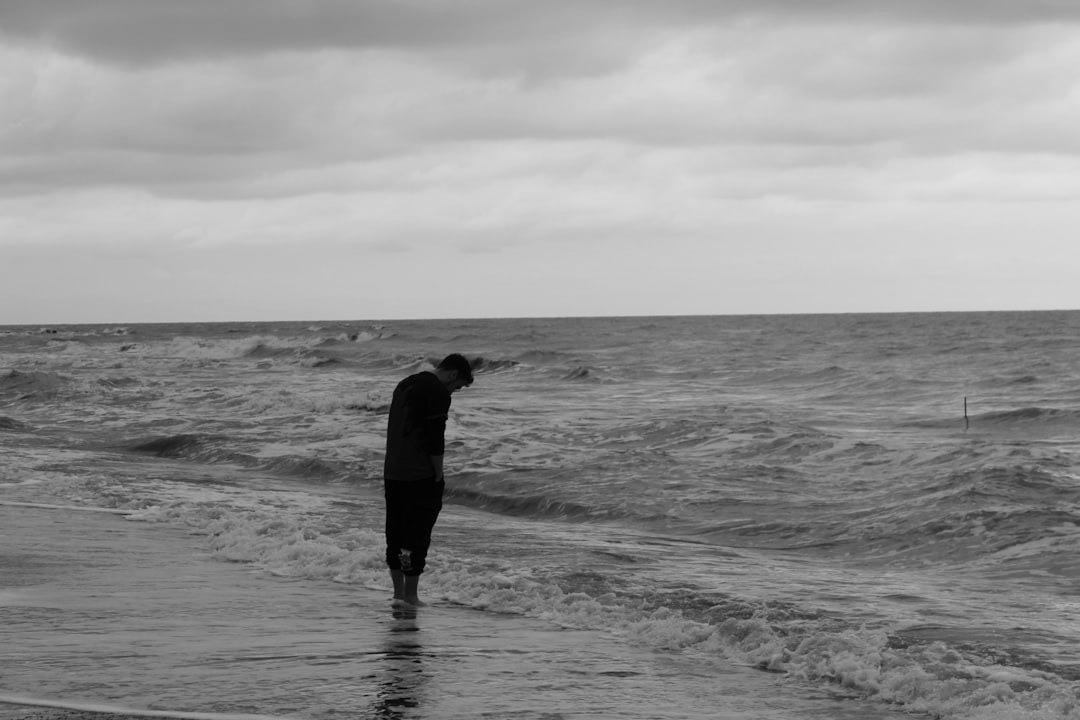
Picture a wave, that builds slowly and invisibly out in the deep water where you can’t track it. It gathers everything around it as it moves, pressure, mass, momentum. By the time it reaches you, it’s enormous. It hits and the world goes sideways. There’s the knock of it, the cold, the disorientation of not knowing where the surface is. For a few seconds you are entirely inside the force of something larger than you.
And then the water pulls back.
The wave recedes. The surface recomposes. The ocean returns to itself because it finished. The wave did exactly what a wave is supposed to do, it traveled the full length of itself and arrived at its own end.
This is what an emotion actually is. A wave. With a beginning, a movement, and a completion. A physiological event your body was designed not to store but to metabolize and release. And this is where most of us diverge from the ocean.
We feel the wave hit. We feel the worst of it, the cold and the force and the groundlessness. And just as it begins to recede, just as the body starts to find the surface again, we turn around and wade back in. We dive into the retreating current. We collect the foam in both hands and pull it back over ourselves.
And then we stand there, soaked and confused, wondering why the sea won’t settle.
The wave does not return. We return to the wave.
We do it with a single thought. A conversation we’ve rehearsed so many times we’ve added dialogue that wasn’t in the original. An argument that ended last week but lives on in the revised version we keep staging inside our own heads, where we finally say the right thing, where the other person finally understands, where it lands the way it should have landed.
We call it processing. We call it not being ready to let go. We call it grief, or anger, or the lasting weight of something unresolved.
And sometimes it is all of those things.
But sometimes, the emotion finished a long time ago and we are the ones who refused to leave the water.
Dr. Jill Bolte Taylor is a Harvard-trained neuroanatomist who studied the brain for years before having the experience of watching her own mind dismantle itself in real time during a stroke at the age of 37. What she mapped from the inside out, gave her an unusually intimate understanding of how emotional experience actually operates in the body.
The physiological lifespan of an emotion is approximately 90 seconds.
The chemical cascade triggered in the brain. The hormonal flood through the bloodstream. The tightening in the chest, the heat behind the eyes, the way the throat closes when you’re trying not to cry in a meeting. All of it. The full biological cycle of what we experience as feeling rises, peaks, and clears the body in a minute and a half.
“If... I remain angry after those 90 seconds have passed, then it is because I have chosen to let that circuit continue to run. Moment by moment, I make the choice to either hook into my neurocircuitry or move back into the present moment.”—Dr. Jill Bolte Taylor
After 90 seconds, the emotion as a physical event is complete.
What persists beyond that is not the emotion. It is the thought you returned to. The story you rebuilt around the feeling. The meaning you assigned to the wave while it was still moving through you, and then kept assigning, long after the water receded.
It is the difference between suffering and prolonged suffering. Between pain and the decision, conscious or not, to keep the pain company.
The story that outlives the feeling
We have no idea how fast we cross from feeling to narrating. It happens in the gap between one breath and the next.
One moment you are in it, the body flooded, the nervous system doing exactly what it was designed to do in response to something real. The next moment you are constructing meaning around it. Why they said it. What it reveals about them. What it reveals about you. What it reminds you of. Where you’ve stood in this exact spot before, in a different room, with a different face across from you, feeling something uncomfortably similar.
The emotion becomes evidence. And evidence requires a case.
So we do what humans do extraordinarily well. We build an entire story around a chemical event that was physiologically complete before we even consciously registered it.
And then we live inside that story. For hours. Days. Sometimes years. Calling it processing. Calling it grief. Calling it working through something.
We do this because we were taught, almost universally, to treat emotional experience as a problem requiring management rather than a physiological event requiring completion. To interrupt, explain, justify, or escape the feeling before it finishes. To reach for analysis at the twenty-second mark. To pick up the phone at fourty. To frame it into language before the body has had a chance to process what the language is even trying to describe.
We stop it before it has a chance to move through us.
And incomplete waves do not disappear. They lose their form and become the water you’re standing in. Shapeless and everywhere. The irritability with no clear source. The exhaustion that sleep doesn’t fix. The low-level sadness that follows you into rooms where nothing is wrong.
That is stored emotion. Present, like a door left slightly open in a room you keep walking past.
Think of it this way. A lit match burns for seconds. Then it goes out. It did what it existed to do. Rumination is relighting the match.
Every replay of the scene. Every imagined confrontation you rehearse in the shower. Every time you call someone not for comfort but for an audience, so you can watch someone else react to the story and feel, briefly, that the feeling is justified and therefore necessary and therefore yours to keep. Every time you return to the thought and give it a few more minutes, a few more dimensions, a few more layers of interpretation.
You are striking the match.
The original flame lasted 90 seconds. What burns now is entirely optional.
What completion actually requires
The 90-second rule is not permission to dismiss pain. It is not a productivity hack for emotional efficiency. This is not me telling you to just get over it.
It’s asking you to stay present for the full cycle. To remain with the physical reality of what is moving through you long enough for it to reach its own end.
Stay for the wave. Feel the force of it without immediately beginning to narrate it. Let the body complete what it started, which it will do naturally if you stop interrupting it.
The grief, the anger, the shame, the fear, none of them asked to become permanent residents. They asked for 90 seconds of your full attention. And most of us, because we were never taught how to give that without flinching, spend years offering them a home instead.
What changes? Not everything, and I won’t pretend otherwise. Some pain is cumulative, old, layered across years and rooms and people who didn’t know the damage they were doing. Some emotions recur because the conditions that created them haven’t changed. The 90-second rule doesn’t dissolve any of that complexity.
But it changes the question you ask.
Instead of why am I still feeling this, you begin asking what you are still thinking about it. Instead of what is wrong with me for not being over it, you begin asking whose story is still running, and who keeps pressing play.
One question locates the problem in your emotional capacity. The other locates it in your relationship to thought. One tells you that you are broken. The other tells you that you are human, and very loyal to your own narratives, and possibly overdue for the conversation where you let the wave finish.
For some people that is the difference between a decade of self-examination and a single moment of recognition. Between the feeling and the story they mistook for it.
I wonder how many people are standing in oceans that already settled.
Braced for a wave that finished hours ago. Holding their breath against an impact that already came and went, moved through them completely, and disappeared without looking back. Standing in calm water wondering why the sea will not settle.
The sea already did.
You are the one still preparing for another wave.
We mistake what visited us for what belongs to us.
But some feelings never asked to become identities.
They only asked to pass through. Ninety seconds was enough.
Until next time,
Stay messy. Stay present. Stay for the full wave.
Eleni
Some memories survive because we visit them daily.—Eleni Rizopoulou
👉 Have you ever realized you were no longer feeling the pain, only replaying it?
Every Monday at 10:30 CEST, the Glorious Fail shows up to meet you where you are, and push you where you’re meant to go.
This space keeps growing because you keep showing up for it.
→ If this resonated, subscribe and stay close.
→ If it sparked something, leave a comment.
→ And if it’s worth passing on, restack it below.
➡️ This is what I write about every week, the unspoken things that run our lives, and the language to finally name them. And if you want more emotional fluent related brain-bending insights follow me on Linkedin.
🫶🫶🫶🫶🫶
🫶🫶🫶🫶🫶